
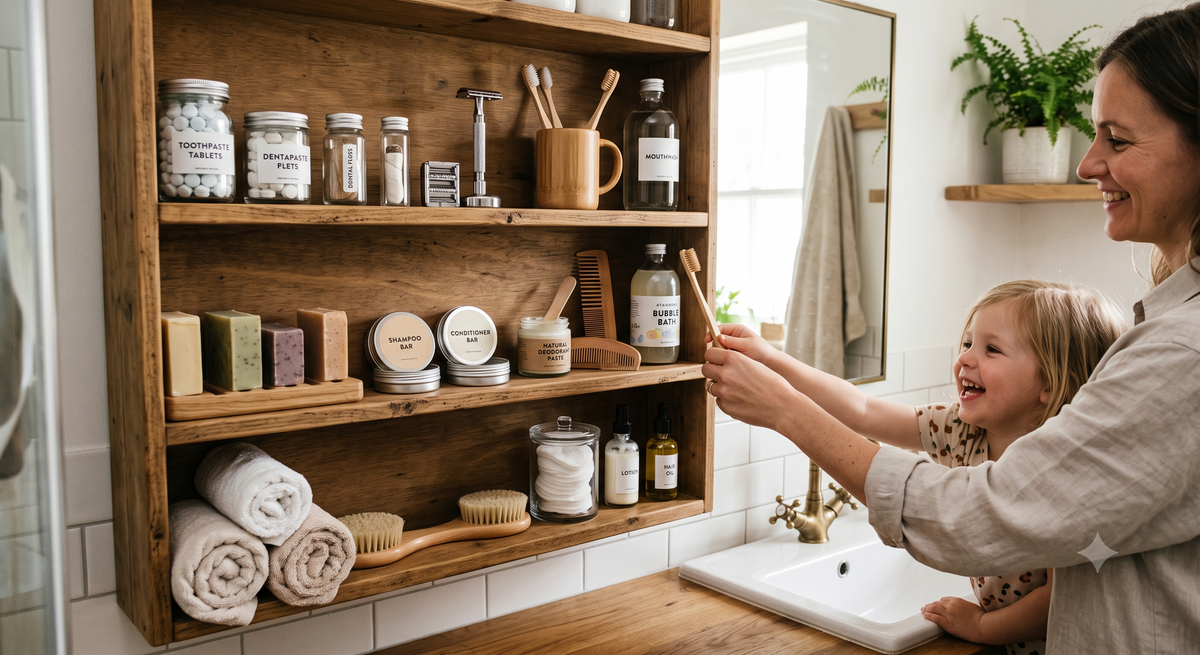
A family bathroom cabinet is a small piece of real estate with an outsized job. It has to hold a six-year-old’s toothbrush next to a teenager’s skincare routine next to whatever the adults in the house actually use — and somehow stay organized enough that nobody is digging through a drawer of tangled cords and half-empty bottles at 7 a.m. on a school morning. Most households solve this by buying in bulk and buying plastic, because it’s cheap and it’s everywhere. But a shared cabinet is actually one of the easiest places in a home to build a plastic-free routine, precisely because so many of the products every age group needs are simple, durable, and easy to standardize across the whole family.
This isn’t about getting a six-year-old to care about sustainability the same way an adult might. It’s about picking products that genuinely work for each stage of a family’s routine — a toothbrush a kid can hold, a hairbrush a teenager will actually use, a soap that doesn’t dry out an adult’s skin — and noticing that a huge share of those products can be the same simple, plastic-free materials across every age group, from the Personal Care collection to the bathroom cabinet itself.
Why One Shared Cabinet Is Harder Than It Looks
A single adult’s bathroom routine is relatively easy to simplify — one toothbrush, one hairbrush, one set of preferences. A family cabinet multiplies that by every person living in the house, and every age group has different needs, different attention spans, and a different tolerance for new products. A toddler needs something durable enough to survive being dropped in the sink daily. A teenager needs a routine that feels like their own, not a hand-me-down from a younger sibling. An adult often just wants everything to work reliably without thinking about it.
The instinct in most households is to buy separate, specialized products for each of those needs — often in plastic packaging, often duplicated across drawers because nobody wants to share. But a lot of that duplication is unnecessary. A well-made bamboo toothbrush works essentially the same way for a ten-year-old as it does for a parent — what differs is color-coding and organization, not the underlying product. The same is true for floss, hairbrushes, and a surprising amount of what lives in a typical cabinet.
What Actually Works for Younger Kids
Younger kids need durability above almost everything else. A toothbrush that gets gnawed on, dropped, and left wet on the counter needs to hold up to all of that without falling apart within weeks — which is part of why a solid bamboo toothbrush tends to outlast a cheap plastic one even under rougher daily use, since the handle isn’t relying on a hollow plastic shell that can crack.
Organization matters just as much as the product itself at this age. A bamboo toothbrush holder with clearly separated slots gives each kid their own spot, which cuts down on the daily “whose toothbrush is this” confusion that happens in any multi-kid bathroom. For younger kids still working on independent hygiene habits, organic bamboo floss that’s simple to use without extra plastic picks or packaging keeps the routine straightforward for a parent supervising from the sink’s edge.
What Actually Works for Teenagers
Teenagers are a genuinely different design problem than younger kids. They’re old enough to want a routine that feels like theirs, not something inherited from a sibling’s old toothbrush holder, and they’re often the first ones in the house experimenting with skincare, haircare, or grooming products beyond the basics. This is where a shared cabinet either works or falls apart — teenagers who feel like they’re using “the kid stuff” tend to disengage from the routine altogether.
A bamboo paddle hair brush works well here because it isn’t styled as a kids’ product or an adult product — it’s simply a well-made hairbrush, which makes it an easy item to hand off to a teenager without the “this is for little kids” resistance. Similarly, a charcoal shampoo bar gives teenagers experimenting with their first “real” haircare routine something that feels a step up from a basic kids’ shampoo, without introducing a separate bottle that clutters the shower. For skincare, a bamboo facial rounds holder paired with reusable rounds gives a teenager starting a skincare routine a low-cost, low-waste way to experiment without generating a pile of single-use cotton pads.
What Holds Up for Adults
Adults tend to already have their routines fairly dialed in, which means the biggest opportunity in a shared cabinet is usually consolidation rather than reinvention. A sisal soap bag extends the life of a bar soap that would otherwise sit in a puddle of its own runoff, which matters more in a busy family bathroom where soap gets used constantly and rarely gets a chance to fully dry between uses. A sisal exfoliating glove or an all-natural loofah sponge are also easy products for adults to adopt without any real change in routine — they simply replace a plastic pouf or synthetic sponge with something that breaks down naturally once it’s worn out.
Adults are also usually the ones managing the household’s supply chain — restocking floss, replacing worn toothbrushes, keeping the cabinet from running dry mid-week. A bamboo floss refill pack or a set of tooth tablet refills makes that restocking simpler, since refills can be bought in bulk without also buying a new plastic dispenser or bottle every single time.
Building a Shared Routine That Actually Sticks
The households that manage a shared cabinet well tend to do a few things consistently. They standardize what can be standardized — same toothbrush style for everyone, just distinguished by holder position or a small marking, rather than every family member using a completely different product. They separate what genuinely needs separating — a teenager’s skincare routine, an adult’s specific shampoo bar — without turning every single item in the cabinet into its own special-case product.
They also treat the cabinet itself as part of the system, not just a place to store things. A toothbrush holder that keeps everyone’s toothbrush upright and separated does more to prevent morning chaos than any amount of verbal reminders about whose brush is whose. And they restock proactively rather than reactively, which is where refill-style products make the biggest practical difference for a household running several people’s routines through one shared space.
What to Look for When Buying for a Multi-Age Household
Durability that doesn’t depend on gentle use. Kids and teenagers alike will use products less carefully than adults do — a solid bamboo handle tends to tolerate that better than a hollow plastic one.
Products that don’t read as “for kids” or “for adults.” A hairbrush or soap dish that works across ages, without an obvious age marker, is easier to hand down or share without resistance.
Refill formats over full replacements. Floss, tooth tablets, and soap are all easier to restock in bulk when the base product — the holder, the dispenser — doesn’t need replacing every time.
Realistic expectations about supervision. Younger kids still need hands-on guidance with any hygiene routine, plastic-free or otherwise; the material of the toothbrush doesn’t change that responsibility.
A Few Myths About Building a Shared Family Routine
“Kids need specifically kid-branded products to build good habits.” What actually builds habits is consistency and supervision, not branding — a well-made, properly sized toothbrush works whether or not it has cartoon characters printed on the handle.
“Teenagers won’t accept anything that isn’t a specific brand name.” Teenagers respond more to feeling like a product is genuinely theirs than to a particular label — a simple, well-designed item they don’t have to share with a younger sibling often does more than a trendy brand name.
“Sharing products across ages is unhygienic.” Personal items like toothbrushes and floss should never be shared regardless of material — the goal here is standardizing which type of product each person uses, not sharing the same physical item.
“A plastic-free cabinet costs significantly more for a whole family.” Refill-style products often even out the cost over time since the base holder or dispenser isn’t repurchased every restock — only the floss, tablets, or soap inside it.
“One family member’s preferences should dictate the whole cabinet.” A shared cabinet works best when it accommodates a few different needs rather than forcing every family member into identical products — durability for kids, independence for teens, and simplicity for adults can all coexist in the same space.
Frequently Asked Questions
What’s the easiest place to start simplifying a family bathroom cabinet? Toothbrushes and holders are usually the easiest starting point, since every family member already needs one and a shared holder solves the organization problem immediately.
How do I get a teenager on board with a shared routine? Give them something that feels like their own product, not a hand-me-down — a well-made hairbrush or shampoo bar tends to land better than a repurposed kids’ item.
Are bamboo personal care products safe for young kids? Yes — a properly sized bamboo toothbrush is just as appropriate for a child’s hygiene routine as a plastic one, with the same supervision expectations that apply to any child’s toothbrushing habits.
How do I keep a shared cabinet from running out of essentials mid-week? Stock refill-style floss and soap in bulk, so restocking is a matter of adding to a drawer rather than buying a whole new dispenser.
Does one shared soap work for everyone in the family? It can, but bar soap in a shared bathroom benefits from proper drainage — a soap bag helps a communal bar last longer under heavier, shared use.
What if different family members have very different skin or hair needs? That’s exactly where it makes sense to let some products stay individual — a shampoo bar for one person and a different formula for another can coexist in the same cabinet without abandoning the plastic-free approach entirely.
Is it worth switching a whole family’s routine at once, or doing it gradually? Gradual works better for most households — swapping one category at a time (toothbrushes first, then floss, then haircare) tends to stick better than an overnight overhaul that asks every family member to adjust simultaneously.
Do these products actually reduce a household’s overall waste? Meaningfully, yes — a family replacing multiple plastic toothbrushes, floss containers, and shampoo bottles every year with durable, refillable, or biodegradable alternatives cuts out a steady stream of single-use plastic that otherwise accumulates across every member of the household.
Bringing It All Together
None of this requires a full bathroom renovation or a family meeting about sustainability values. It starts with noticing what’s already duplicated across drawers — three types of floss, four half-used soap bottles, toothbrushes nobody can tell apart — and replacing that clutter with a smaller number of well-made, shareable products. The American Bamboo Society notes that bamboo’s rapid regrowth makes it one of the more renewable materials for exactly this kind of everyday, high-turnover household use, which matters when a single cabinet is serving several people’s daily routines at once. And as the Plastic Pollution Coalition points out, most plastic waste in a household comes from exactly this kind of small, repeated, everyday purchase rather than one single big item — which means a family cabinet is actually a high-leverage place to make a change. Groups like the Story of Stuff Project have also written extensively about how household consumption habits, multiplied across a family, add up faster than most people expect. A shared, simplified, plastic-free cabinet is a small change, but it’s one that gets repeated by every person in the house, every single day — which is exactly the kind of change that adds up.
🌿 Continue Your Journey
Enjoyed this article? Here are three ways to take the next step:
🌱 Make The Bamboo Switch™ Learn how one small change can create lasting impact.
🌎 Made The Bamboo Switch™ Join a growing community choosing progress over perfection.
🤝 Become a Bamboo Switch Guide Help others discover thoughtful, sustainable living while earning rewards.
Share:
Coffee & Tea Rituals for Cooler Mornings
Humidity, Mold, and Bamboo: Why Fall's Damp Weather Calls for a Material Check