
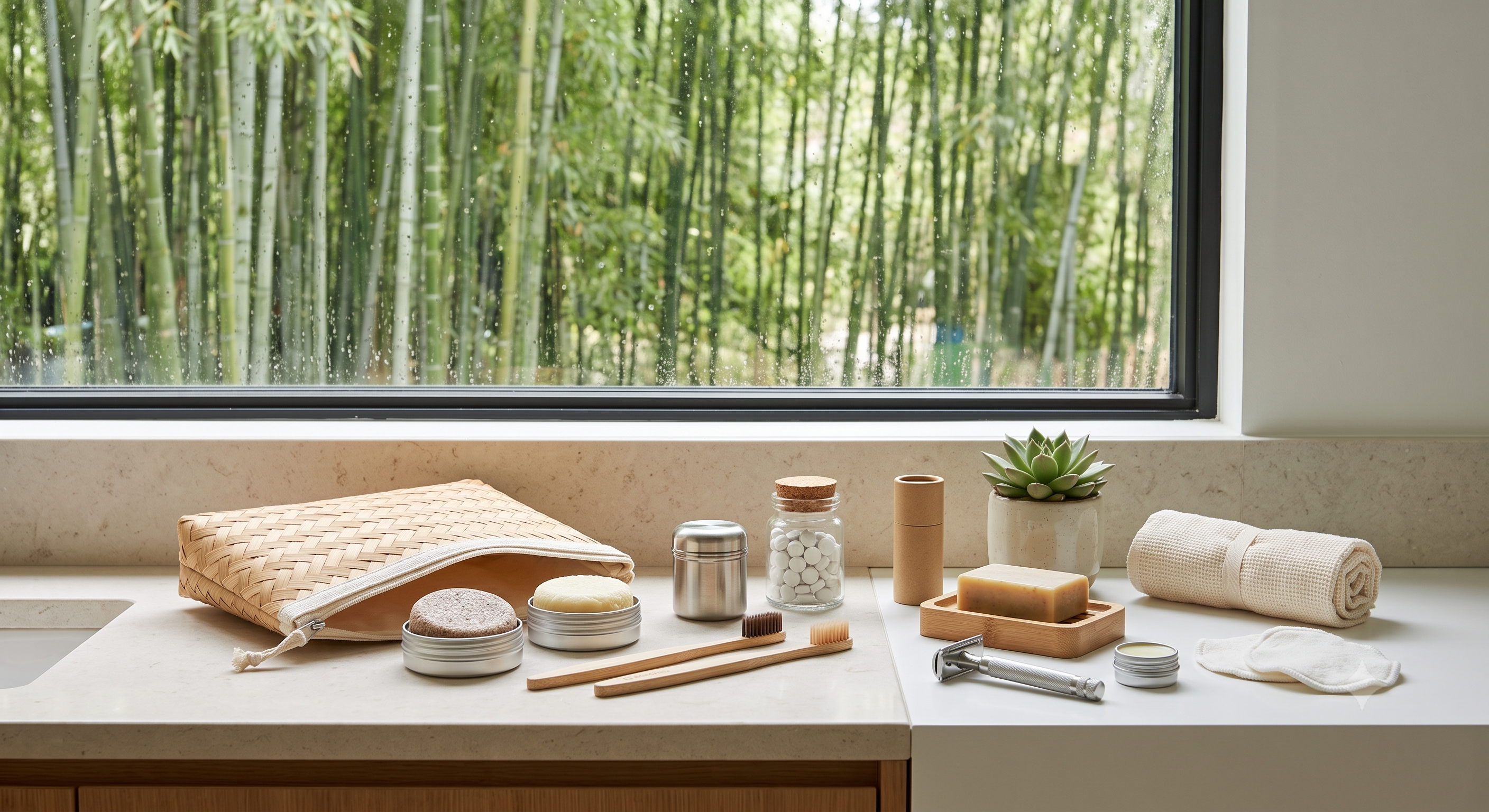
The last stretch of summer is prime travel season — a final beach weekend, a road trip before school starts back up, a camping trip squeezed in before the weather turns. And every one of those trips comes with the same small, annoying ritual: standing at the bathroom counter deciding what personal care items are small enough, sturdy enough, and TSA-compliant enough to survive the trip in a carry-on.
For most people, that ritual ends the same way it always has — travel-size plastic bottles, a spare plastic toothbrush from the drugstore, a mini deodorant that’s more packaging than product. It’s a routine built entirely around single-use convenience, which is exactly backwards from how a good travel kit should work. The best travel gear is reusable, packable, and durable enough to make the same trip a hundred times over. A plastic-free personal care kit built around solid, bamboo-based tools checks every one of those boxes, and it solves the TSA liquids problem almost by accident, since solid products don’t count against the 3-1-1 rule in the first place.
Why Travel Is Where Plastic Habits Quietly Reset
At home, a lot of people have already made small swaps toward more sustainable personal care. But travel has a way of undoing that progress overnight, because the assumption is that “on the road” products need to be disposable, mini, and different from what’s used every day. That assumption is what fills airport security bins with half-used bottles of liquid toiletries that get tossed the moment they trip the 3.4-ounce limit.
The Plastic Pollution Coalition has pointed out that travel-size and single-use plastic packaging is disproportionately represented in ocean and landfill waste relative to how briefly it’s actually used — a mini shampoo bottle might get squeezed for three days and then discarded, packaging and all. A travel kit built around solid, reusable tools breaks that pattern entirely, because nothing in it is designed to be used once and thrown away.
Building the Kit: What Actually Belongs in a Carry-On
A genuinely plastic-free personal care travel kit starts with the same fundamentals as an everyday routine, just packed a little more deliberately.
Teeth. A bamboo toothbrush takes up the same space as a plastic one but skips the packaging waste, and a set of tooth tablets replaces liquid or paste toothpaste entirely — they’re solid, they don’t count against a liquids limit, and a small pouch holds enough for a week-long trip without adding meaningful weight. For flossing, organic bamboo floss or a compact bamboo floss refill pack rounds out the kit without a single plastic floss pick in sight.
Skin and hair. A charcoal shampoo bar is arguably the single best travel swap available, since it replaces an entire liquid bottle with a solid bar that lasts for dozens of washes and never has to go in a quart-size security bag. Tucked into a sisal soap bag, it dries between uses instead of turning a toiletry pouch into a damp mess, which matters more on a trip than it ever does at home. A compact all-natural loofah sponge or a sisal exfoliating glove packs flat and dries quickly too, which is a real advantage in a shared bathroom or a tent.
Small details. Bamboo cotton ear buds take up almost no space, and if hair care is part of the routine, a bamboo paddle hairbrush is compact enough for a weekend bag while still holding up to daily use once you’re back home. Together, this is a full personal care routine that fits in a pouch smaller than a typical liquids-only kit, since almost nothing in it needs its own bottle.
Why Solid, Bamboo-Based Products Travel Better Than Plastic Ones
Travel is genuinely hard on gear. Bags get tossed into overhead bins, dropped on tent floors, and packed tight enough that anything fragile or leak-prone becomes a liability. This is where bamboo’s natural properties do real work rather than just sounding good on a label. Bamboo fiber is naturally antimicrobial and moisture-resistant, according to the American Bamboo Society, which matters a great deal for something like a toothbrush handle that spends a week in a humid toiletry bag between uses.
Solid products have a structural advantage too. A shampoo bar can’t leak through airport security screening the way a squeeze bottle sometimes does, and a tooth tablet can’t crack open and coat the inside of a bag the way a tube of toothpaste occasionally does when altitude and pressure changes work against it. None of this is a minor convenience — anyone who’s had a bottle burst inside a suitcase knows exactly how much of a trip that can ruin before it’s even started.
What to Pack Depending on the Trip
Weekend getaway. A toothbrush, tooth tablets, a small shampoo bar in a sisal soap bag, and a loofah sponge cover the basics without adding real weight to a carry-on.
Camping or backcountry trip. The same core kit works, with the sisal exfoliating glove doing double duty as a way to feel clean without a proper shower, and the shampoo bar working fine with cold water from a jug or stream when a hot shower isn’t an option.
International travel. Solid products sidestep liquid restrictions and customs questions about unlabeled toiletries entirely, since there’s nothing in the kit that reads as a liquid, gel, or aerosol on a screening form.
Extended stays. For trips longer than a week or two, doubling up on tooth tablets and packing a spare floss refill is simpler than trying to buy plastic travel-size replacements at a destination where the preferred brand might not be sold at all.
The Real Advantage: One Kit, Every Trip
Maybe the most underrated part of a plastic-free travel kit is that it doesn’t need to be rebuilt before every trip. A pouch of solid personal care items sits packed and ready between uses, unlike a liquids bag that has to be refilled from full-size bottles at home before every departure. That means less last-minute scrambling at the bathroom counter the night before a flight, and less waste generated by buying yet another set of mini toiletries because the last set got tossed at security or ran out mid-trip.
Over a year of regular travel, this adds up in ways that go beyond convenience. A household that travels four or five times a year and buys a fresh set of travel-size liquids each time is generating a meaningful stack of empty mini bottles annually — most of which aren’t recycled in practice, since Eco-Cycle notes that travel-size plastic containers are frequently too small for municipal sorting equipment to process correctly, meaning they end up in a landfill even when tossed in a recycling bin with good intentions. A packed kit of solid, reusable tools sidesteps that entirely, trip after trip.
What to Look for in a Travel-Ready Personal Care Product
Solid over liquid whenever possible. A bar, tablet, or powder format almost always travels better than a liquid one, both for TSA compliance and for how it holds up inside a packed bag.
A breathable, quick-dry case or pouch. A sisal soap bag or similar mesh-style container keeps a damp bar from turning a toiletry pouch musty, which matters more on multi-day trips than it does for a single overnight.
Compact without being flimsy. A travel-size product that falls apart after one trip isn’t actually saving anything — durability matters just as much on the road as it does at home.
A brand that backs up its shipping claims. Since a lot of travel gear gets ordered online before a trip, it’s worth checking whether a retailer stands behind its environmental claims beyond the product itself — at Bamboo Switch®, that includes our Climate Commitment to offset shipping emissions on every order, travel kit included.
A Few Myths About Plastic-Free Travel
“Solid toiletries won’t survive airport security or altitude changes.” Solid bars, tablets, and powders are actually more stable under pressure and temperature changes than liquids, which is exactly why they don’t fall under the TSA’s liquids restrictions in the first place.
“A shampoo bar isn’t as effective as bottled shampoo.” A well-formulated bar cleans just as effectively as its liquid counterpart — the difference is concentration and format, not performance, and a single bar typically outlasts two or three bottles of liquid shampoo.
“Plastic-free travel gear takes up more space than the mini bottles it replaces.” Usually the opposite is true. A shampoo bar, tooth tablets, and a bamboo toothbrush collectively take up less room than a liquids bag full of separate mini bottles, since there’s no bottle shape or empty headspace to account for.
“This only makes sense for people who travel constantly.” Even one or two trips a year adds up to a noticeable pile of mini toiletry waste over time — the kit pays for itself in avoided repurchases well before it becomes a frequent-flyer habit.
“Bamboo products are too fragile for rough travel like camping.” Properly finished solid bamboo handles hold up to daily handling and moisture exposure at least as well as plastic, and unlike plastic, they don’t become brittle or crack from repeated temperature swings inside a hot car or a cold tent.
Frequently Asked Questions
Can solid shampoo bars and tooth tablets go through airport security without issue? Yes — since they’re solid rather than liquid, gel, or aerosol, they aren’t subject to the 3.4-ounce liquids rule and can go in a carry-on without a separate quart-size bag.
How long does a shampoo bar last on a trip? A single charcoal shampoo bar typically covers dozens of washes, which is more than enough for even an extended multi-week trip, let alone a long weekend.
What’s the best way to keep a shampoo bar dry between uses while traveling? A breathable pouch like a sisal soap bag lets the bar air out between uses, which prevents it from sitting in a damp puddle inside a sealed container.
Is a bamboo toothbrush actually more hygienic for travel than a plastic one? Bamboo’s natural antimicrobial properties give it an edge in humid, enclosed conditions like a packed toiletry bag, where bacteria and odor can build up faster than they would sitting openly on a bathroom counter at home.
Do tooth tablets work as well as regular toothpaste? Yes — a tooth tablet is chewed and activated with brushing the same way toothpaste is used, just without the tube, and a small refill pack easily covers a week or two of travel.
What should I pack for a camping trip specifically, versus a hotel stay? The core kit stays the same either way; a sisal exfoliating glove and a compact loofah sponge are especially useful for camping, where a proper shower isn’t always available every day.
Is it worth building a dedicated travel kit, or just packing from an everyday routine? A dedicated, pre-packed kit saves the most time, since it sits ready to grab before a trip instead of requiring a last-minute assembly from full-size bathroom products the night before departure.
How do I keep a travel kit from getting lost in a larger suitcase? A small pouch or the toothbrush holder from home works well as a dedicated travel case — keeping the kit in one consistent spot means it’s the same routine whether you’re packing for a weekend or a two-week trip.
Building a plastic-free travel kit isn’t about a single dramatic overhaul — it’s a handful of solid, durable swaps that happen to solve the TSA liquids problem, the leaky-bottle problem, and the year-over-year waste problem all at once. Once it’s packed, it stays packed, ready for the next trip without another run to the travel-size aisle. For anyone squeezing in one more getaway before summer ends, it’s a genuinely easy place to start simplifying how you pack, not just what you pack with.
🌿 Continue Your Journey
Enjoyed this article? Here are three ways to take the next step:
🌱 Make The Bamboo Switch™ Learn how one small change can create lasting impact.
🌎 Made The Bamboo Switch™ Join a growing community choosing progress over perfection.
🤝 Become a Bamboo Switch Guide Help others discover thoughtful, sustainable living while earning rewards.
Share:
Sunday Meal Prep for a Busy School Year: A Zero-Waste Kitchen Routine
End-of-Summer Bathroom Refresh: What to Replace Before Fall