
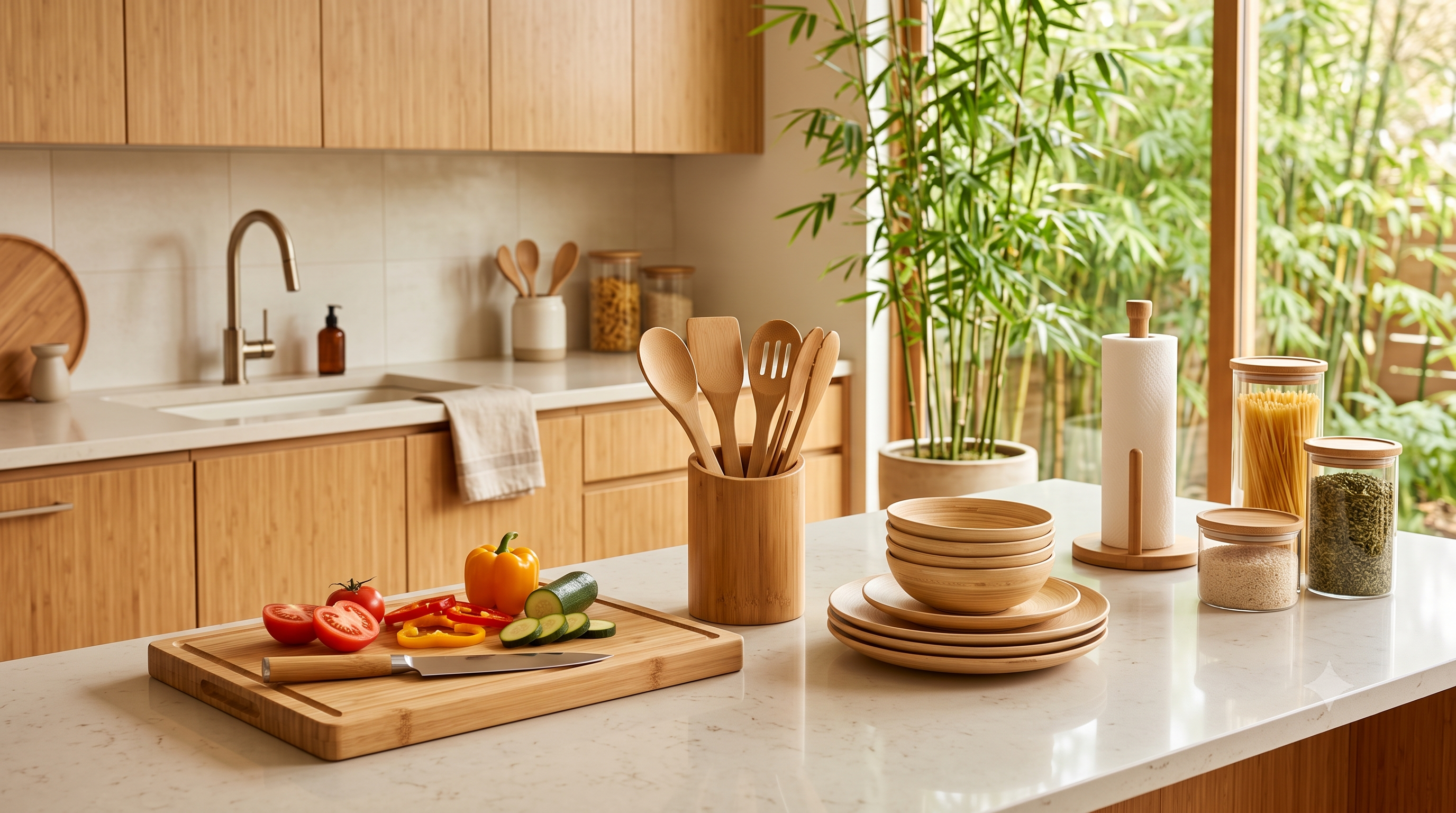
As backyard cookout season starts winding down and kitchens shift back into weeknight, back-to-school mode, it's worth taking a fresh look at what your everyday kitchen tools are actually made of. A cutting board, a set of tongs, a serving bowl — these are some of the most-used tools in any home, touched daily, exposed to heat, knives, and food contact in a way few other household objects experience. That combination makes the kitchen a genuinely demanding testing ground for a material, not just a place where "sustainable" swaps happen to look nice.
This is the third and final article in our Bamboo — More Than Just a Grass series. Our first guide covered what bamboo actually is, and our second looked at why it outperforms plastic in the bathroom — this one turns to the kitchen, where heat, knife contact, and constant hand-washing create a different but equally demanding set of conditions.
What Makes the Kitchen Different From Other Rooms
A bathroom's biggest challenge for a material is sustained humidity. A kitchen's challenge is more varied: direct heat from a stovetop or grill, repeated knife contact on a cutting surface, frequent hand-washing, and constant handling of raw and cooked food, sometimes within the same few minutes. Any one of these would be a reasonable stress test for a material; a kitchen tool typically faces all of them in a single day.
Plastic kitchen tools became the default for the same reason plastic took over the bathroom: low manufacturing cost, not superior performance. Over time, that shows up in familiar ways — plastic cutting boards develop deep knife grooves that harbor bacteria no amount of scrubbing fully removes, plastic tongs warp or discolor near direct heat, and plastic utensils can leach a faint chemical taste into hot food over years of use. The Plastic Pollution Coalition notes that plastic doesn't biodegrade at the end of its life either — it simply fragments into smaller pieces, including the microplastics shed from worn plastic cutting boards and utensils directly into the food prepared on them.
Why Bamboo's Fiber Structure Matters Here
Bamboo's dense, naturally strong grass fiber gives it two advantages that matter enormously in a kitchen: it's harder than most plastics, and it's naturally antimicrobial.
The hardness matters for cutting surfaces specifically. A 16" bamboo cutting board resists deep knife grooves better than most plastic boards, and because bamboo is naturally antimicrobial, whatever shallow marks do develop over time don't become the same kind of bacterial breeding ground that scored plastic does. That's a meaningfully different food-safety profile for a surface that handles raw meat, produce, and everything in between.
Heat Tolerance: Where Bamboo Genuinely Shines
Direct heat is where the difference between bamboo and plastic is most obvious. A 19" bamboo barbecue grilling tong holds up to grill-level heat without the warping or melting that cheap plastic tongs are prone to near an open flame — bamboo tolerates high, dry heat considerably better, since it's sustained direct flame contact (not brief heat exposure) that damages any handled tool, wood, bamboo, or otherwise.
This heat tolerance extends to everyday cooking too, not just grilling. Bamboo utensils don't soften, warp, or transfer a plastic taste into hot food the way some lower-quality plastic tools can after repeated exposure to a hot pan — a small detail, but one that adds up over years of daily cooking.
Why This Matters for Food Safety Specifically
Food safety is where bamboo's antimicrobial properties do some of their most important work. A cutting board, in particular, is handled by hand and knife constantly, often switching between raw meat and produce within the same meal prep session. Bamboo's natural resistance to bacterial buildup doesn't replace basic food safety practice — you should still use separate boards or sides for raw meat and produce, the same as with any material — but it does mean the surface itself isn't actively working against you the way heavily scored plastic can.
A bamboo charcuterie board with a built-in utensil drawer extends this same benefit to serving, not just prep — a surface that's handling cheese, cured meats, and fruit for guests benefits from the same natural resistance to bacterial buildup as a prep board does.
A Late-Summer Kitchen Reset
As backyard entertaining winds down and kitchens shift back into weeknight routines and school-lunch prep, early August is a natural moment to take stock of which kitchen tools have quietly been overdue for a swap. A 4-piece bamboo kitchen utensil set is an easy place to start if your everyday spoons and spatulas are looking worn from a summer of heavy use, and a bamboo cutting board is worth replacing if your current one has visible knife grooves that have gone past the point of a quick sand-and-oil refresh.
This is also a good moment to reset storage habits heading into busier fall cooking — the same zero-waste approach applies just as well to coffee and tea storage on the pantry side of the kitchen, if that's next on your list.
What the Research Says About Material Choice
This isn't just a Bamboo Switch talking point — it reflects broader material science. The American Bamboo Society notes bamboo's structural strength for its weight, a property that translates directly into kitchen tools that hold up to years of cutting, stirring, and heat exposure. And because bamboo regenerates from an existing rhizome network rather than requiring decades of tree growth, the material replacing your worn plastic tools doesn't come with the resource cost of a hardwood alternative.
The Rainforest Alliance also works with farming communities more broadly on practices that protect the same forests and water systems a sustainably sourced kitchen material depends on — worth keeping in mind alongside the material question itself, since where any raw material comes from matters as much as what it's made into.
What to Look for When Buying Bamboo Kitchen Products
Solid bamboo construction. As with any bamboo product, a thin veneer over a composite core won't deliver the same hardness or antimicrobial benefit as a solid piece — check the product description rather than relying on the name alone.
Food-safe finish. Kitchen tools need a finish that's safe for direct food contact, not just moisture-resistant — look for products that specify a food-safe oil or wax finish.
Appropriate care instructions. Bamboo cutting boards and utensils should be hand-washed and air-dried, not run through a dishwasher, which exposes bamboo to prolonged heat and moisture that can cause warping over time.
Realistic lifespan expectations. A well-made bamboo kitchen tool should be positioned as a multi-year piece, not a disposable accessory — part of why we back our materials with commitments like our Climate Commitment to offset shipping emissions across every order.
A Few Myths About Bamboo in the Kitchen
"Plastic cutting boards are more sanitary because they can go in the dishwasher." Dishwasher-safe doesn't mean bacteria-resistant — plastic boards develop knife grooves that trap bacteria regardless of how they're washed. A bamboo board's natural antimicrobial properties address the underlying bacterial concern more directly, even though it should be hand-washed rather than run through a dishwasher.
"Bamboo utensils can't handle high heat like metal or silicone can." Bamboo tolerates high, dry heat well, including direct grill and stovetop use — it's sustained contact with an open flame (uncommon for typical stirring or serving) that damages a bamboo tool, not everyday cooking heat.
"Wood and bamboo cutting boards are basically the same thing." They share some properties, but bamboo is botanically a grass, not a wood, and its fiber structure tends to be denser and harder than many common cutting board woods, which is part of why it resists deep knife grooves comparatively well.
"A bamboo cutting board needs constant special maintenance." Basic care — hand-washing, air-drying, and an occasional food-safe oil treatment every few months — is all a quality bamboo cutting board needs, comparable to the care most wood cutting boards require.
"Bamboo utensils will scratch my nonstick pans less than metal, but that's the only advantage." Scratch resistance for nonstick cookware is a real benefit, but it's not the only one — bamboo utensils also handle sustained cooking heat without softening or transferring taste into food, and they hold up structurally over years of stirring and scraping in a way that some lower-quality plastic utensils don't.
Frequently Asked Questions
Can I use the same bamboo cutting board for raw meat and produce? As with any cutting board material, it's best practice to use separate boards or dedicated sides for raw meat and produce — bamboo's antimicrobial properties are a real benefit, but they don't replace standard food safety practice.
Is it safe to put a bamboo cutting board in the dishwasher? No — the prolonged heat and moisture of a dishwasher cycle can cause bamboo to warp or crack over time. Hand-washing with warm soapy water and air-drying keeps a bamboo board performing well for years.
How often should I oil a bamboo cutting board? Roughly every one to two months with regular use, using a food-safe mineral oil, keeps the surface conditioned and helps prevent drying or cracking — a quick sniff or visual check of the surface (dull, dry-looking wood) is usually a good enough reminder.
Will bamboo kitchen tools eventually crack or split? With proper care — avoiding the dishwasher, drying thoroughly after washing, and occasional oiling for cutting boards — bamboo kitchen tools typically last for years without cracking. Prolonged soaking or rapid temperature changes (like a hot board rinsed in cold water) are the more common causes of premature cracking.
Is bamboo food-safe for direct contact, the same as it is for personal care items? Yes — quality bamboo kitchen products use a food-safe finish specifically formulated for direct food contact, which is a different (and more tightly regulated) standard than the finishes used on non-food items like a hairbrush or toothbrush stand.
Does a bamboo cutting board affect knife sharpness the way glass or stone boards can? No — bamboo is gentler on blade edges than glass, stone, or ceramic cutting surfaces, which tend to dull knives faster. It falls in a similar range to hardwood cutting boards in terms of how well it preserves an edge over repeated use.
Is it worth having more than one bamboo cutting board in a kitchen? For most households, yes — having a dedicated board for raw meat and a separate one for produce or bread simplifies food safety without needing to wash and dry a single board between every step of a meal.
Where This Series Goes From Here
This wraps up our three-part series on bamboo as a material — from what bamboo actually is and why its fast-regenerating biology makes it renewable, to why it outperforms plastic in the bathroom's humidity and heat cycling, to why it holds up in one of the most demanding, high-contact rooms in the house.
For now, take a look at our full Kitchen Essentials collection and consider which worn plastic tool is overdue for a swap as your kitchen shifts back into a busier fall routine. Every Bamboo Switch® order ships with carbon-neutral shipping, so the same material story that started with a fast-growing grass carries all the way through to your door.
🌿 Continue Your Journey
Enjoyed this article? Here are three ways to take the next step:
🌱 Make The Bamboo Switch™ Learn how one small change can create lasting impact.
🌎 Made The Bamboo Switch™ Join a growing community choosing progress over perfection.
🤝 Become a Bamboo Switch Guide Help others discover thoughtful, sustainable living while earning rewards.
Share:
Why Bamboo Outperforms Plastic in the Bathroom
The Hidden Plastic in Your Morning Routine You Haven't Swapped Yet