
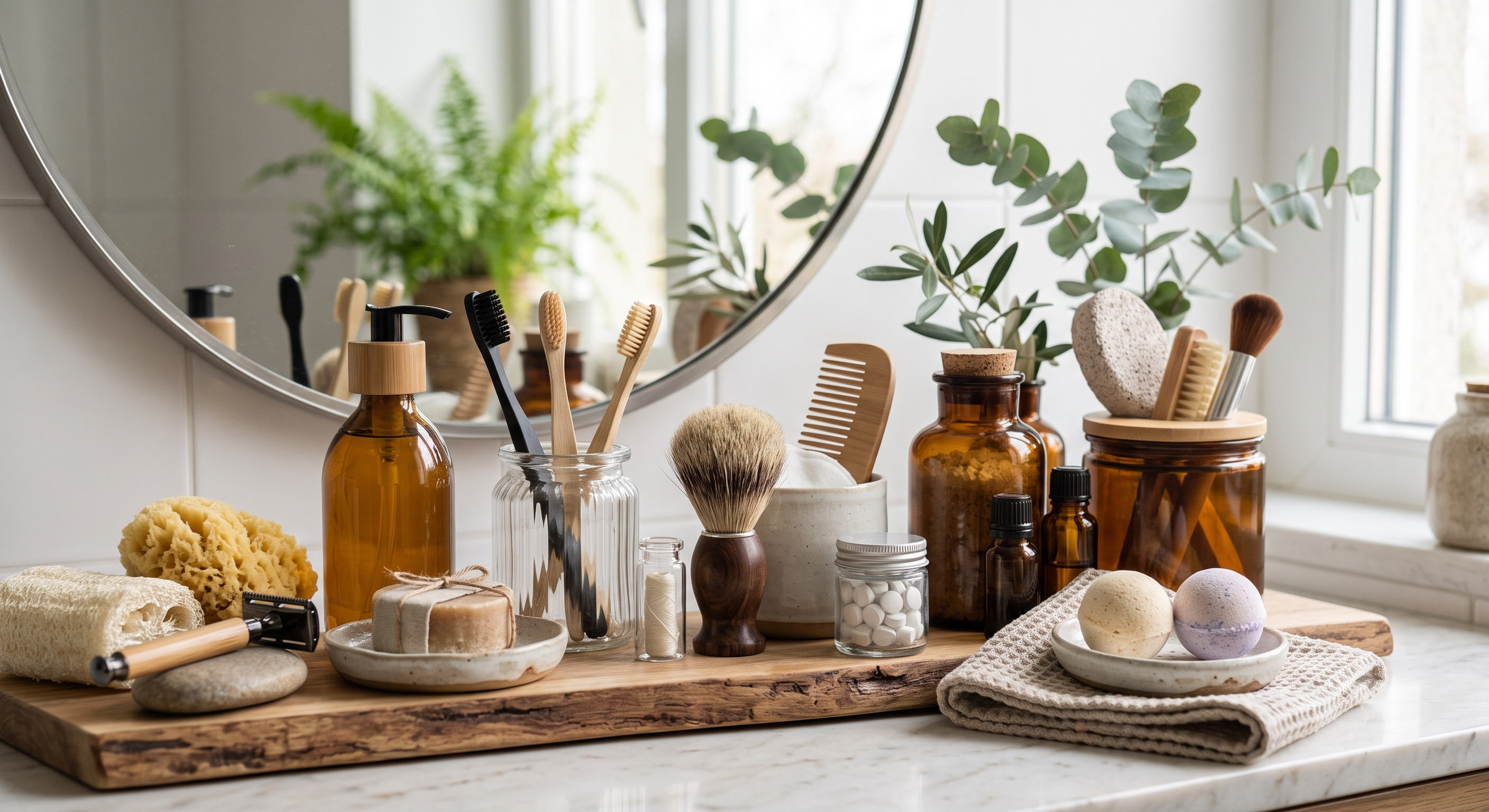
Open most bathroom cabinets and you'll find the same quiet clutter: a suction-cup caddy sagging off the shower wall, a rubber-backed mat curling at the corners, a plastic toilet brush holder that's gone slightly cloudy with age. None of it was chosen, exactly — it's just what accumulated, one convenient purchase at a time. And yet the bathroom is one of the smallest, most frequently used rooms in the house, which makes it one of the easiest to actually notice when it feels calm instead of cluttered.
This is the first article in our new Plastic-Free Home & Bath series. Over the coming weeks, we'll cover everything from building a zero-waste laundry routine to organizing bathroom storage without reaching for more plastic bins. Today, we're starting where most people spend the most time: turning a standard bathroom into a calmer, more intentional space, one bamboo piece at a time.
Why the Bathroom Tends to Accumulate So Much Plastic
It's not an accident that bathrooms end up this way. Bath mats, shower caddies, and toilet brush holders are all items people tend to buy quickly, often as an afterthought during a move or a bathroom refresh, and plastic has simply been the default, lowest-cost material for decades. The Plastic Pollution Coalition notes that the vast majority of all plastic ever produced still exists somewhere in the environment today, because it doesn't biodegrade — it just breaks into smaller and smaller pieces called microplastics that end up in water, soil, and household dust.
A bathroom is a particularly humid, high-turnover environment, which means the plastic fixtures living there are also the ones most likely to degrade, discolor, and need replacing every year or two — a cycle that's easy to stop noticing once it becomes routine. Nonprofits like Eco-Cycle frame this less as a single big decision and more as a default: reach for the durable, reusable option first, and treat the disposable, short-lived version as the exception rather than the rule.
Why Bamboo Actually Performs Better in This Room
Here's what often gets missed in conversations about sustainable swaps: bamboo isn't just a nicer-looking material for the Home & Bath collection — it's frequently a better-performing one, for reasons specific to how bathrooms function.
Bathrooms are damp environments by nature, and this is exactly where bamboo's natural antimicrobial properties matter most. Bamboo resists the buildup of bacteria, mold, and odor better than plastic does under repeated moisture exposure — precisely the condition a toilet brush, bath mat, or shower caddy lives in every single day. Plastic, by contrast, tends to develop micro-scratches with use that trap bacteria and are difficult to fully clean, which is one of the less-discussed reasons plastic bathroom tools can start to smell or discolor faster than expected.
Bamboo also holds up structurally in humid conditions without warping the way some plastics can under repeated heat and moisture cycles — think of a plastic shower caddy that's gone slightly brittle after a year on the wall. And because bamboo is a fast-growing, renewable grass rather than a petroleum-based material, it breaks down naturally at the end of its life instead of persisting in a landfill for centuries.
Room-by-Room: Styling a Calmer Bathroom
The easiest way to approach this isn't to replace everything on the same weekend — it's to work through the room in the order things naturally wear out, starting with whatever's most visible.
In the shower and bath. A bamboo bath mat replaces the synthetic, rubber-backed mats common in most bathrooms, and its slatted design dries faster between uses, which means less trapped moisture for mold to grow in. A hanging bamboo shower caddy swaps out the plastic suction-cup organizers that tend to fall off the wall within a few months anyway, for something sturdier and considerably nicer to look at.
Around the toilet. A bamboo toilet cleaning brush and stand is one of the most-used tools in the room, and pairing it with a bamboo toilet paper holder with drawer keeps a spare roll tucked away without a plastic stand taking up floor space. If floor space is tight, a freestanding bamboo toilet paper stand is an easy alternative.
At the sink and on the wall. A bamboo wall hook rack gives towels and robes a home off the floor without adding another plastic fixture to the wall, and a bamboo foot stool is a sturdy, good-looking alternative to the plastic step stools often used to help kids reach the sink.
Soap and cleansing. A bar of natural, plastic-free soap paired with a bamboo soap dish eliminates the plastic bottle pump that liquid soap typically comes in, and a well-drained soap lift keeps a bar from turning into a soggy mess between uses.
None of this needs to happen at once. A bathroom refresh like this tends to grow the same way any room does — one piece added each time something wears out, until eventually the whole room feels considered rather than accumulated.
What to Look for When Buying Bamboo Bathroom Products
Not all "bamboo" products are created equal, and it's worth knowing what separates a well-made piece from one that's bamboo in name only.
Finish and treatment. Bathroom items need to handle daily moisture, so look for products described with a natural oil or wax finish suited to wet environments, rather than raw, untreated bamboo.
Solid construction versus composite. Some lower-cost "bamboo" items are actually a thin bamboo veneer over a plastic core — technically containing bamboo, but not delivering the durability or biodegradability of a solid piece. Reading the material description closely, not just the product name, usually clears this up.
Source transparency. A brand that can speak specifically to where its bamboo is grown and how it's processed is generally a better sign than vague "eco-friendly" language with no supporting detail. This is also where a company's broader environmental commitments matter — at Bamboo Switch®, that's part of why we're transparent about programs like our Climate Commitment to offset shipping emissions, rather than only marketing the product material itself.
Realistic expectations about lifespan. A quality bamboo bathroom product should be marketed and priced as something built to last years with basic care, not as a disposable item. If a listing reads more like a one-season novelty than a long-term fixture, that's usually a signal about the underlying build quality.
A Simple 30-Day Bathroom Styling Challenge
If refreshing the whole room feels like too much at once, spreading it out over a month tends to make the change stick better than trying to do it all in one weekend.
Week 1: Swap the bath mat and add a soap dish with a bar of natural soap. These are the two most visible changes, and the easiest to notice immediately.
Week 2: Replace the toilet brush and holder. It's a small, low-effort change that removes a surprisingly long-lived piece of plastic from daily rotation.
Week 3: Add the hanging shower caddy. It's a slightly bigger purchase, so it's worth waiting until your current one is actually due for replacement.
Week 4: Round out the room with smaller fixtures — a wall hook rack, a foot stool if you have kids, or a toilet paper stand — based on whatever your bathroom is still missing.
By the end of the month, most of the plastic that used to define the room has been replaced with something that actually looks and feels intentional, without it ever becoming a single overwhelming project.
A Few Myths About Bamboo Bathroom Styling
"Won't bamboo get moldy in a humid bathroom?" This is the most common concern, and it's a fair one — but it's largely a manufacturing and care question, not a material flaw. Well-made bamboo bathroom products are typically treated to resist moisture, and simply allowing items like a bath mat or toilet brush to air-dry fully between uses keeps them performing well for years.
"Isn't bamboo more expensive than plastic in the long run?" Often the opposite. A plastic toilet brush or shower caddy is frequently replaced every year or two as it degrades or discolors — meaning the "cheap" plastic option is often a recurring cost. A well-made bamboo equivalent, cared for properly, tends to last considerably longer.
"Doesn't bamboo look more 'crunchy' or utilitarian than a nice bathroom?" This one's largely outdated. Bamboo's natural grain and warm tone have become a common feature in higher-end bathroom design specifically because it looks more intentional than most plastic fixtures, not less.
"Is bamboo sourcing actually sustainable, or is it a marketing claim?" It depends heavily on the source, which is worth asking about with any bamboo product you buy. Bamboo is a fast-growing grass that can regenerate without replanting and typically requires no pesticides or fertilizer to thrive — fundamentally different from slower-growing hardwood forestry. Groups like the Story of Stuff Project have done extensive public education on how to evaluate sustainability claims across consumer goods generally — a useful lens for evaluating any "eco-friendly" product, bamboo included, rather than taking a label at face value.
Frequently Asked Questions
Do bamboo bath mats get slippery when wet? Most are designed with slatted or ridged surfaces specifically to allow water to drain through rather than pool on top, which actually improves grip compared to a soaked synthetic mat sitting in standing water.
Will humidity eventually damage bamboo bathroom fixtures? With basic care — periodic drying, avoiding prolonged standing water, and an occasional wipe-down — bamboo bathroom products hold up well to normal daily humidity for years. It's prolonged, uninterrupted soaking that shortens the lifespan of most bathroom materials, plastic included.
Is switching my whole bathroom at once necessary to make a difference? No. Swapping even a single high-visibility item, like a bath mat or shower caddy, changes how the whole room feels immediately — there's no minimum threshold required before a swap "counts."
What should I do with the plastic items I'm replacing? If they still work, the most sustainable option is usually to keep using them until they wear out rather than discarding something functional — save the new bamboo version for when the old one actually needs replacing.
Is this swap realistic for a rental or shared bathroom? Yes — nearly everything in this guide is a freestanding or easily removable item (a bath mat, a hanging shower caddy, a foot stool) rather than a fixture that requires installation or a landlord's permission. That makes the bathroom one of the more renter-friendly rooms to start a plastic-free refresh in.
Where should I start if I can only make one change? Start with whichever item you look at most and like least — for most people, that's the bath mat or the shower caddy, since both sit in plain view every single day.
Where This Series Goes Next
This article is meant to be the foundation for everything else we'll cover in the Plastic-Free Home & Bath series — the next guide moves out of the bathroom and into the laundry room, building a full zero-waste laundry routine with the same room-by-room approach.
For now, take a look at our full Home & Bath collection and consider which single swap you'd actually notice every day — that's the one worth making first. Every calmer, more intentional room starts with a small, sustainable decision, and every Bamboo Switch® order along the way ships with carbon-neutral shipping, so the swap itself starts with a lighter footprint too.
🌿 Continue Your Journey
Enjoyed this article? Here are three ways to take the next step:
🌱 Make The Bamboo Switch™ Learn how one small change can create lasting impact.
🌎 Made The Bamboo Switch™ Join a growing community choosing progress over perfection.
🤝 Become a Bamboo Switch Guide Help others discover thoughtful, sustainable living while earning rewards.
Share:
Tips for an Eco-Friendly Dining Experience
Your Morning Ritual, Reimagined: A Sustainable Coffee & Tea Routine You'll Love