
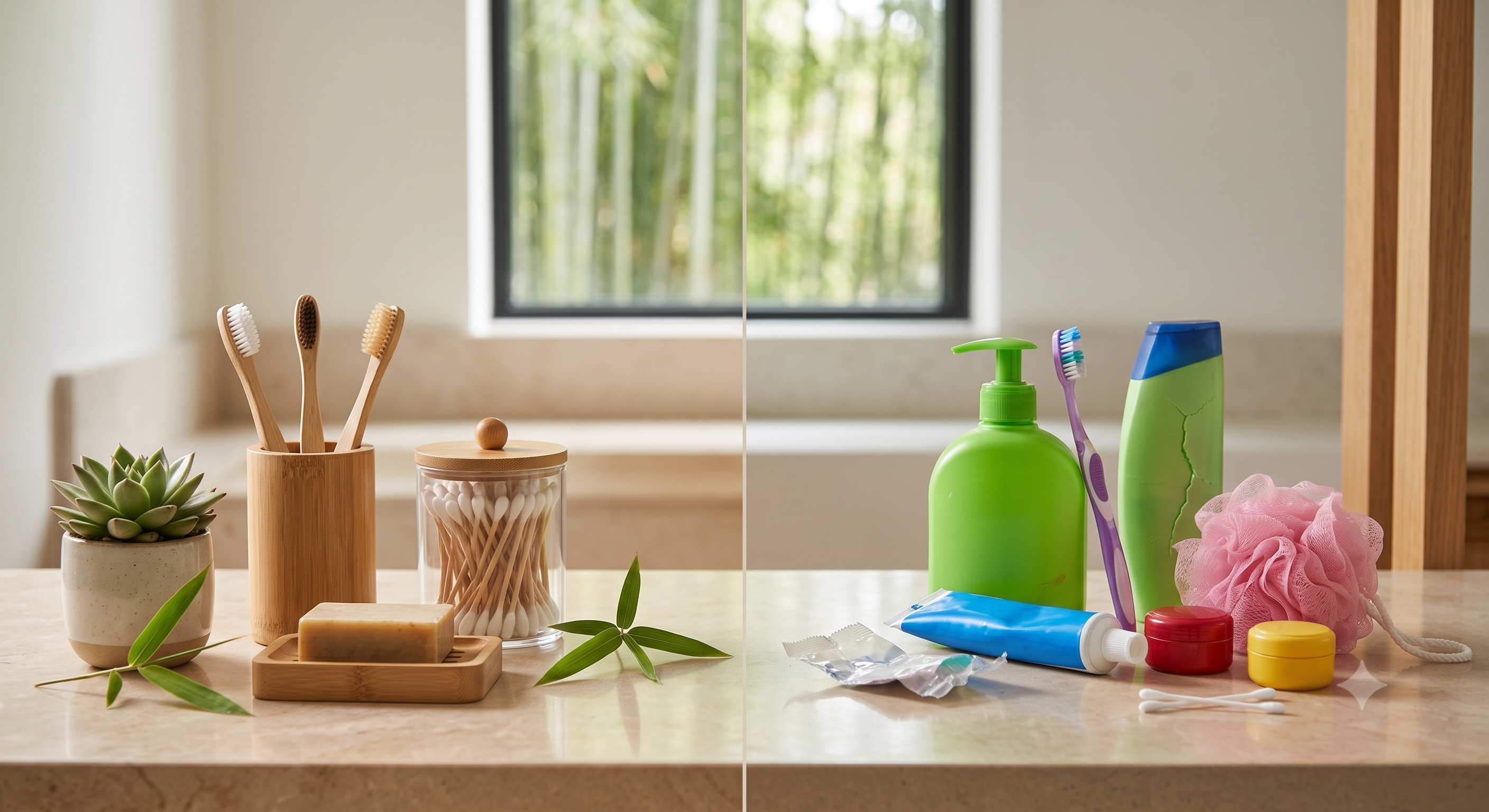
Not every household product gets the same level of scrutiny, and that’s mostly reasonable — a plastic storage bin in a closet doesn’t touch your body, so its material rarely matters beyond durability. But a hairbrush glides across your scalp every day. A loofah scrubs directly against skin. A soap dish holds something that sits in standing water and then gets rubbed all over your body the next morning. For this specific category of product — the ones in constant, direct skin contact — the material underneath genuinely matters in ways that go beyond how “eco-friendly” the label sounds.
This is a material comparison, not a product roundup. The goal here is to walk through what actually happens, physically and biologically, when bamboo and natural fiber sit against skin every day versus when plastic does the same job — and why that difference shows up in ways you can actually feel, not just in abstract sustainability terms.
Why Skin-Contact Products Deserve a Different Standard
A product’s material matters more or less depending entirely on how it’s used. A plastic mixing bowl gets washed and put away — it’s rarely in prolonged, repeated contact with skin the way a hairbrush or loofah is. Skin-contact personal care items are used daily, often for extended periods, in one of the most moisture-heavy environments in the home: a bathroom. That combination — daily use, prolonged contact, high humidity — is exactly the condition where material differences stop being theoretical and start being something you can notice.
This is why a bamboo paddle hairbrush or a natural loofah sponge deserves a closer look than, say, a plastic bucket in the garage. The stakes for material choice are genuinely different when the product is in direct, sustained contact with your body every single day.
How Bamboo Behaves Against Skin, Physically
Bamboo has a naturally antimicrobial quality that comes from compounds within the plant fiber itself, not from an added chemical treatment, according to the American Bamboo Society. That matters enormously for anything that sits damp against skin repeatedly, since it’s exactly the condition where bacteria and odor-causing microbes tend to build up on synthetic materials. A bamboo toothbrush handle held in a wet hand daily behaves differently over time than a plastic handle in the same condition, and the same principle applies to a hairbrush handle gripped every morning.
Texture matters too. Solid bamboo has a naturally smooth, slightly warm surface compared to plastic, which tends to feel cooler and harder against skin. This isn’t just a preference difference — plastic hairbrush bristles are typically molded nylon, which can create more friction and static against hair than a natural-pin bamboo brush, especially in dry conditions or drier hair types.
How Plastic Behaves Against Skin, Physically
Plastic isn’t inherently harmful in short-term or one-time contact, but its behavior changes under the specific conditions personal care products face: repeated moisture exposure, daily friction, and years of continuous use. Plastic surfaces don’t have bamboo’s natural antimicrobial compounds, which means bacteria and biofilm can build up more readily on a plastic hairbrush or a synthetic pouf over time, particularly in the crevices and folds that are hard to fully dry between uses.
Synthetic loofahs and shower poufs illustrate this most clearly. Made from plastic mesh, they hold moisture in their folds longer than a natural fiber alternative, creating a genuinely more hospitable environment for bacterial growth between showers. According to the Plastic Pollution Coalition, synthetic fibers like these also shed microscopic plastic particles during ordinary use, meaning a portion of what’s scrubbing against your skin each shower is fragmenting plastic mesh rather than the plant fiber it’s often designed to visually resemble.
Loofah: Natural Fiber vs. Synthetic Mesh
This comparison is one of the clearest in the entire personal care category. A genuine natural loofah sponge is grown from an actual loofah plant, dried, and used in its natural fibrous form — no plastic involved at any stage. A synthetic pouf, by contrast, is manufactured plastic mesh, shaped and colored to resemble a natural sponge, but chemically and structurally nothing like one.
The practical differences show up quickly: a natural loofah dries faster between uses because its fiber structure doesn’t trap water in tight synthetic folds the way mesh does, which reduces the damp conditions bacteria need to thrive. It also composts fully at the end of its useful life, while a synthetic pouf persists as plastic waste indefinitely. For sensitive skin, a sisal exfoliating glove offers a gentler natural-fiber option with the same underlying material advantages.
Hairbrush: Solid Bamboo vs. Molded Plastic
A hairbrush is used daily, often multiple times, dragged directly across scalp and hair for months or years before replacement. A bamboo paddle hairbrush uses wide, naturally finished pins that tend to glide more gently through hair than rigid plastic-and-nylon bristles, and bamboo’s natural properties reduce the static buildup that plastic brushes are especially prone to, particularly in drier climates or seasons.
Handle grip matters too — solid bamboo tends to have a naturally secure, slightly textured grip even with wet hands fresh out of the shower, whereas smooth molded plastic can become slippery under the same conditions. It’s a small detail, but one that shows up in daily use in a way that a spec sheet wouldn’t capture.
Soap and Storage: Where It Sits Between Uses
What holds your soap or shampoo bar between uses matters almost as much as the bar itself. A bamboo shampoo and soap bar lift dish is slatted specifically to let a bar drain and dry between uses, rather than sitting in a puddle the way it often does on a flat plastic dish. A bar sitting in standing water softens, wastes faster, and creates the same kind of damp, bacteria-friendly environment that a synthetic pouf does — a detail that’s easy to overlook since the dish itself never touches skin directly, even though it directly affects what does.
A sisal soap saver bag solves a related problem for bars that have worn down to a sliver — instead of a thin piece of soap going soft and unusable in a plastic dish, the bag lets you use it fully while doubling as a light natural exfoliant against skin during use.
The Small Daily-Contact Details
A few smaller personal care items round out this comparison, even though they get less attention than a hairbrush or loofah. A bamboo facial rounds holder keeps reusable facial rounds dry and organized rather than sitting damp in a plastic dish between washes, and bamboo cotton ear buds replace a plastic stem with one that breaks down naturally, even though the actual cotton tip that contacts skin is functionally the same either way.
A charcoal shampoo bar is also worth mentioning here, not because the bar itself is a material comparison in the same sense, but because pairing it with a proper draining dish and a soap saver bag completes the full skin-contact ecosystem this article is describing — the bar, and everything it touches and sits on between uses.
What to Look for in Skin-Contact Products Specifically
Solid material, not a thin coating. A skin-contact product benefits most from being solid bamboo or genuine natural fiber all the way through, not a decorative layer over a plastic core, since the surface that actually touches skin needs to be the real material.
Drainage and dry-time design. Anything that sits wet between uses — a soap dish, a loofah, a brush — performs better when it’s actually designed to dry quickly, which is a bigger factor in hygiene than most people initially assume.
Finish appropriate for direct contact. A product meant to touch skin daily should have a finish suited to that use, smooth and free of anything that could irritate skin with repeated contact.
Replacement cycle honesty. A hairbrush or loofah is going to wear out eventually regardless of material — what matters is that a natural fiber version breaks down responsibly at the end of its life instead of persisting indefinitely once replaced. Eco-Cycle notes that end-of-life impact is one of the most overlooked factors when households evaluate personal care products, since most attention goes to what a product does while it’s in use, not what happens to it once it’s worn out.
A Few Myths About Bamboo and Skin
“Plastic personal care products are just as hygienic as natural materials, since they get washed too.” Washing helps, but plastic’s lack of natural antimicrobial properties combined with its tendency to trap moisture in mesh or crevices makes it a more hospitable environment for bacterial buildup than bamboo or natural fiber over repeated daily use.
“A synthetic loofah looks and feels close enough to a natural one that the material doesn’t matter.” Materially, they’re quite different — a synthetic pouf is plastic mesh that sheds microfiber and traps moisture, while a natural loofah is plant fiber that dries faster and composts fully at the end of its life.
“Bamboo hairbrushes don’t detangle as well as plastic ones.” Most people find a bamboo paddle hairbrush performs comparably or better on detangling, since wider, naturally finished pins tend to glide through hair with less friction and static than rigid plastic bristles.
“A soap dish is just a soap dish — the material doesn’t really affect anything.” A dish that lets a bar drain properly, like a slatted bamboo lift dish, meaningfully extends how long a bar lasts and keeps it from sitting in the kind of standing water that shortens its usable life.
“Skin can’t actually tell the difference between materials in daily use.” Texture, temperature, static, and grip are all physically different between bamboo and plastic, and these differences tend to become more noticeable, not less, the more consistently a product is used against skin every day.
Frequently Asked Questions
Does bamboo’s antimicrobial property mean it never needs to be cleaned? No — regular cleaning is still important for any personal care item, but bamboo’s natural resistance to bacterial buildup means it requires less aggressive maintenance to stay hygienic between cleanings compared to plastic.
Is a natural loofah actually more hygienic than a synthetic pouf? Generally, yes — a natural loofah dries faster between uses, which reduces the damp conditions bacteria need, whereas synthetic mesh tends to hold moisture longer in its folds.
Will a bamboo hairbrush work well on thick or curly hair? Wide-set, naturally finished pins on a bamboo paddle hairbrush tend to glide through thicker or curlier hair with less snagging than tightly packed plastic bristles, though individual results vary by hair texture.
Does a soap dish material really affect how long a bar of soap lasts? Yes — a bar sitting in standing water on a flat, non-draining dish softens and wears down faster than one on a slatted bamboo lift dish that allows proper drainage between uses.
How should I care for bamboo personal care products to keep them hygienic? Letting them dry fully between uses, avoiding prolonged submersion in water, and an occasional wipe-down are usually enough — bamboo’s natural properties do a lot of the hygienic work on their own.
Are all “natural fiber” personal care products equally good for skin? Not automatically — fiber type, finish, and construction all matter, which is why checking a product description for solid, genuine material rather than a synthetic blend labeled “natural-look” is worth the extra minute.
Is there a meaningful cost difference between bamboo and plastic personal care items? Pricing varies by product, but bamboo and natural fiber personal care items are generally comparable in cost to their plastic equivalents, while typically lasting as long or longer with proper care.
What’s the easiest first swap for someone focused specifically on skin-contact products? A natural loofah sponge or a bamboo paddle hairbrush tends to be the most noticeable first swap, since both are used daily and the material difference is immediately apparent in texture and feel.
The products that spend the most time in direct contact with your body are, somewhat counterintuitively, often the ones that get the least scrutiny when it comes to material choice — a toothbrush gets attention because it’s an obvious swap, but a hairbrush, a loofah, and a soap dish quietly do the same job, in the same damp environment, day after day. Taking a closer look at what those specific products are made of, and how that material behaves under daily, direct-contact conditions, is where bamboo and natural fiber tend to make the most noticeable difference of anywhere in a personal care routine. Our full Personal Care collection is built around exactly that principle, material by material.
🌿 Continue Your Journey
Enjoyed this article? Here are three ways to take the next step:
🌱 Make The Bamboo Switch™ Learn how one small change can create lasting impact.
🌎 Made The Bamboo Switch™ Join a growing community choosing progress over perfection.
🤝 Become a Bamboo Switch Guide Help others discover thoughtful, sustainable living while earning rewards.
Share:
Back-to-School Lunch Prep: Building a Zero-Waste Kids' Lunch Kit
The 10-Minute Bathroom Reset: A Weekly Plastic-Free Maintenance Routine