
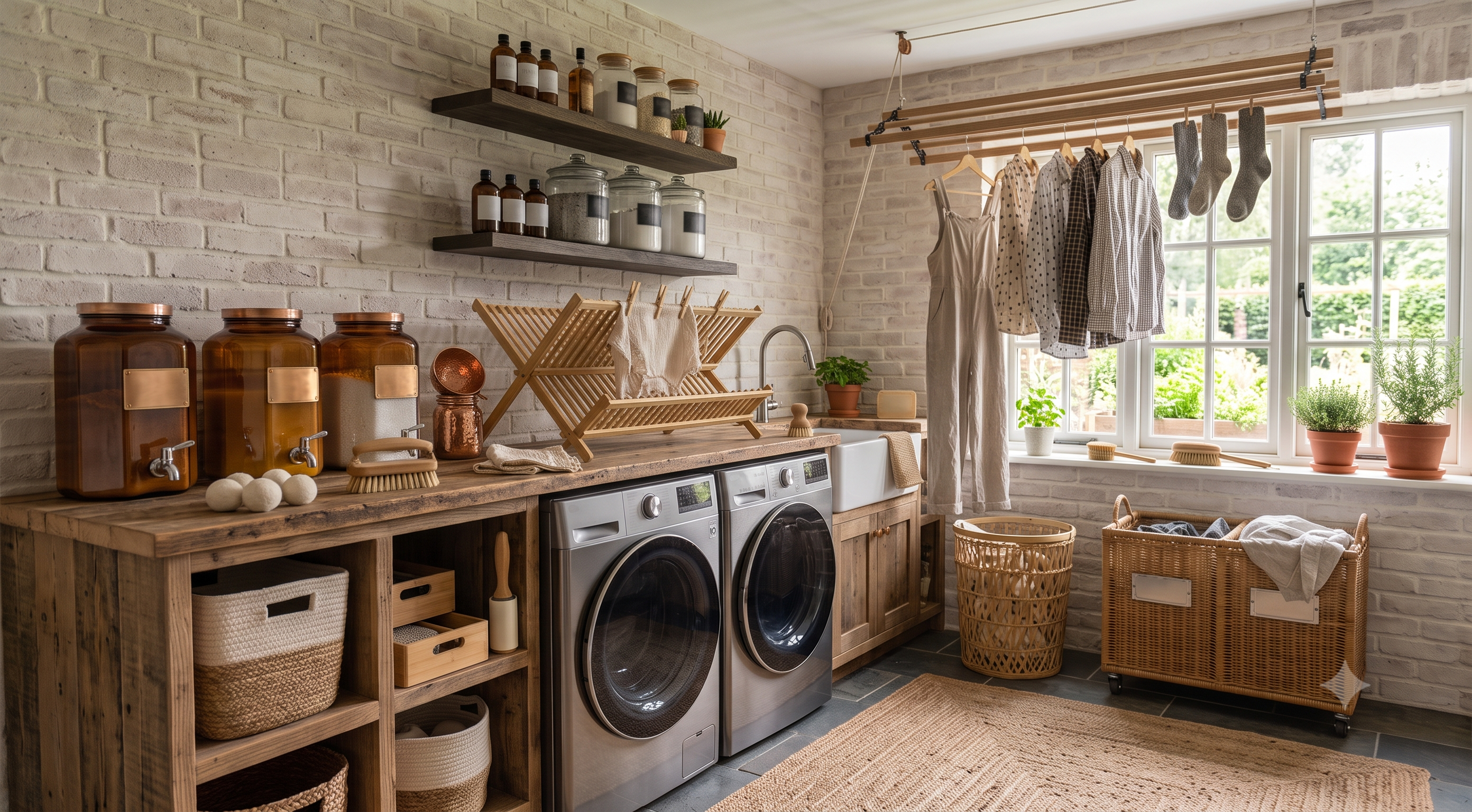
Laundry is one of the most repetitive chores in any home, which makes it an easy place for plastic to accumulate without anyone noticing. A jug of liquid detergent, a box of single-use dryer sheets, a plastic scoop that came free with the last bottle — none of it feels like a big decision in the moment, but multiplied across a year of wash loads, laundry quietly produces a surprising amount of packaging waste for a chore that's mostly just water, agitation, and time.
This is the second article in our Plastic-Free Home & Bath series. Our first guide covered styling a calmer, plastic-free bathroom — this one moves down the hall to the laundry room, building a full zero-waste routine step by step.
Why Laundry Is a Surprisingly Concentrated Source of Plastic
Most people don't think of laundry as a "plastic" chore the way they might think of food packaging or personal care, but the numbers add up quickly. The Plastic Pollution Coalition notes that the vast majority of all plastic ever produced still exists somewhere in the environment today, because it doesn't biodegrade — it simply fragments into smaller pieces over time. A typical household runs several loads a week, and each one potentially touches a plastic detergent jug, a box of dryer sheets (often coated in a synthetic fragrance layer and discarded after a single use), and a scoop or two that eventually cracks and gets tossed.
There's also a less visible cost: every wash cycle involving synthetic fabrics sheds tiny plastic microfibers into the wastewater, a source of ocean microplastic pollution that nonprofits like Ocean Conservancy have tracked as a meaningful and largely invisible contributor, separate from the packaging question entirely. None of this means laundry is done "wrong" — it just means a few small changes to the routine can meaningfully reduce the plastic tied to a chore most households run several times a week.
Step One: Washing
The foundation of a zero-waste laundry routine starts with what goes into the machine itself. A laundry powder detergent replaces the plastic jug that liquid detergent typically comes in, and a bamboo laundry scoop measures it out without a flimsy plastic scoop that tends to crack within a season or two.
For delicates, a set of organic cotton delicate bags protects finer fabrics during the wash cycle, replacing single-use mesh bags that wear out quickly, and a cotton mesh wash bag works well for smaller loose items like socks that otherwise go missing in the machine.
Step Two: Drying
Once the wash cycle is covered, drying is the next place plastic tends to hide, mostly in the form of single-use dryer sheets. A set of wool dryer balls replaces dryer sheets entirely, softening fabric and reducing static naturally through friction rather than a synthetic fragrance coating, and a single set is reused for hundreds of loads before it needs replacing. For larger loads, XL wool dryer balls cover more fabric at once and can also shorten drying time slightly, since they help separate items and improve airflow through the load.
Step Three: Carrying and Sorting
The routine doesn't end at the machine. An XL cotton delicates and laundry bag is useful for carrying a full load to and from a shared laundry room, replacing the flimsy plastic hampers or disposable bags some households end up using for the same purpose. If you're stocking up on laundry room essentials all at once, our Laundry Essential Bundle gathers several of these pieces together, which is often simpler than building the routine product by product if you're starting completely fresh.
Why This Approach Actually Works Better, Not Just Cleaner
Bamboo and natural fiber laundry tools bring something to this routine beyond sustainability: they tend to outperform their disposable counterparts on the specific job they're doing. Wool dryer balls soften fabric through mechanical friction and airflow rather than a chemical coating, which means there's no synthetic fragrance residue left on clothing — a genuine plus for households with sensitive skin or fragrance sensitivities.
A bamboo laundry scoop also holds up structurally in a way that thin, brittle plastic scoops often don't after repeated scooping from a dense powder detergent, and because it's a durable, reusable tool rather than a giveaway accessory, it doesn't end up cracked and replaced every few months the way plastic scoops often do.
And because a set of dryer balls or delicate bags is meant to be reused for years rather than restocked, the cost of doing laundry actually goes down over time. A box of dryer sheets is a recurring purchase every month or two; a set of wool dryer balls is a purchase made once that lasts for hundreds of loads afterward.
The Real Cost of a Disposable Laundry Routine
It's worth running the numbers on what a fully disposable laundry routine costs over a year, since the comparison rarely comes up until after you've already made the switch. A household running one load of laundry most days is buying a box of dryer sheets every four to six weeks and a jug of liquid detergent roughly monthly, on top of a plastic scoop that eventually cracks and gets replaced along with it.
A set of wool dryer balls and a bag of powder detergent replace all of that with a handful of purchases spread across the same year — often at a comparable or lower total cost, and without a single dryer sheet box or empty detergent jug added to the trash in the process. The savings aren't dramatic on any single load, but a set of dryer balls used for hundreds of loads adds up the same way the disposable version's recurring cost would have, week after week, year after year.
What to Look for When Choosing Laundry Products
Not every "eco" laundry product on the market delivers on the claim, and it's worth knowing what to check before you buy.
Material and fiber source. Wool dryer balls should be 100% wool felt, not a wool-wrapped synthetic core — the felting process matters for how well they hold their shape and last over hundreds of loads.
Detergent ingredient transparency. A powder detergent's ingredient list is worth a quick check the same way a personal care product's would be — look for a brand that discloses its full formulation rather than a vague "plant-based" claim with no supporting detail. Groups like the Story of Stuff Project have done extensive public education on how to evaluate sustainability claims across household goods generally — a useful lens for laundry products specifically, since "green" labeling in this category varies widely in what it actually means.
Packaging, not just the product. Some "eco" laundry products still ship in heavy plastic packaging that undercuts the point of the swap. This is also where a brand's broader environmental commitments matter — at Bamboo Switch®, that's part of why we're transparent about programs like our Climate Commitment to offset shipping emissions across every order.
Realistic expectations about lifespan. Wool dryer balls and a bamboo scoop should be marketed as multi-year tools, not disposable accessories. If a listing reads more like a one-season novelty than a long-term fixture, that's usually a signal about the underlying build quality.
A Simple Zero-Waste Laundry Checklist
If you're building this routine from scratch rather than swapping one item at a time, here's a simple starting point:
- A powder detergent instead of a plastic jug of liquid
- A bamboo laundry scoop for measuring
- A set of wool dryer balls to replace dryer sheets
- Cotton delicate bags for finer fabrics
- A larger cotton laundry bag for carrying loads to and from the machine
Everything on this list gets reused load after load, which means each time you do laundry, the routine gets a little more effortless rather than starting from scratch.
A Few Myths About Zero-Waste Laundry
"Wool dryer balls don't actually reduce static the way dryer sheets do." In most loads, wool dryer balls perform comparably, especially once fabrics are fully dry — the main difference is that a dryer sheet's static reduction comes from a chemical coating, while a wool dryer ball's comes from separating fabric and improving airflow. For very static-prone synthetic fabrics, adding a few extra minutes to the dry cycle or using more than one dryer ball generally closes any remaining gap.
"Powder detergent doesn't dissolve as well as liquid." This was a more common issue with older formulations and colder wash temperatures. Most modern powder detergents dissolve fully in a standard warm or cold cycle, and using the scoop to distribute the powder directly into the drum (rather than a dispenser drawer) generally solves any remaining residue issue.
"This is more expensive than a jug of detergent and a box of dryer sheets." Usually the opposite over time. Dryer sheets are a recurring purchase every month or two; a set of wool dryer balls lasts for hundreds of loads before replacement is needed, which changes the math considerably across a year of laundry.
"Cotton delicate bags aren't durable enough for regular use." Well-made organic cotton delicate bags are designed for repeated wash cycles and typically outlast the disposable mesh bags they replace, provided they're air-dried rather than put through high heat in the dryer.
Common Questions About a Zero-Waste Laundry Routine
How many wool dryer balls should I use per load? Three to six balls per standard load is typical, with larger or bulkier loads benefiting from the higher end of that range or a pair of XL dryer balls instead.
Do wool dryer balls work for scented laundry? Yes — a few drops of essential oil on a dryer ball before tossing it in adds a light scent without the synthetic fragrance chemicals found in most commercial dryer sheets.
How long does a set of wool dryer balls actually last? With normal use, a quality set lasts one to two years or roughly 1,000 loads before the felting starts to wear thin enough to need replacing — considerably longer than a box of dryer sheets used at the same pace.
Is powder detergent safe for high-efficiency (HE) washing machines? Most powder detergents are formulated to work in HE machines; checking the packaging for an HE designation is worth doing once when you switch, the same as you would with any new detergent format.
Can I switch just part of my laundry routine, or does it need to be all at once? Any single swap — the detergent, the dryer sheets, or the delicate bags — reduces plastic waste immediately on its own. Most households find it easiest to swap the dryer sheets first, since that's usually the simplest, most immediate change to notice.
Where This Hub Goes From Here
This is the second stop in our Plastic-Free Home & Bath series, building on the bathroom styling guide we covered first. For now, take a look at our full Home & Bath collection and consider which part of your laundry routine is overdue for a swap. And if you're looking for more support along the way, Made The Bamboo Switch™ is a good place to see how other households have rebuilt their own routines one load at a time.
🌿 Continue Your Journey
Enjoyed this article? Here are three ways to take the next step:
🌱 Make The Bamboo Switch™ Learn how one small change can create lasting impact.
🌎 Made The Bamboo Switch™ Join a growing community choosing progress over perfection.
🤝 Become a Bamboo Switch Guide Help others discover thoughtful, sustainable living while earning rewards.
Share:
Why Personal Care Plastic Matters (And How to Start Swapping It Out)
Your Laid-Back Backyard Tea Gathering