
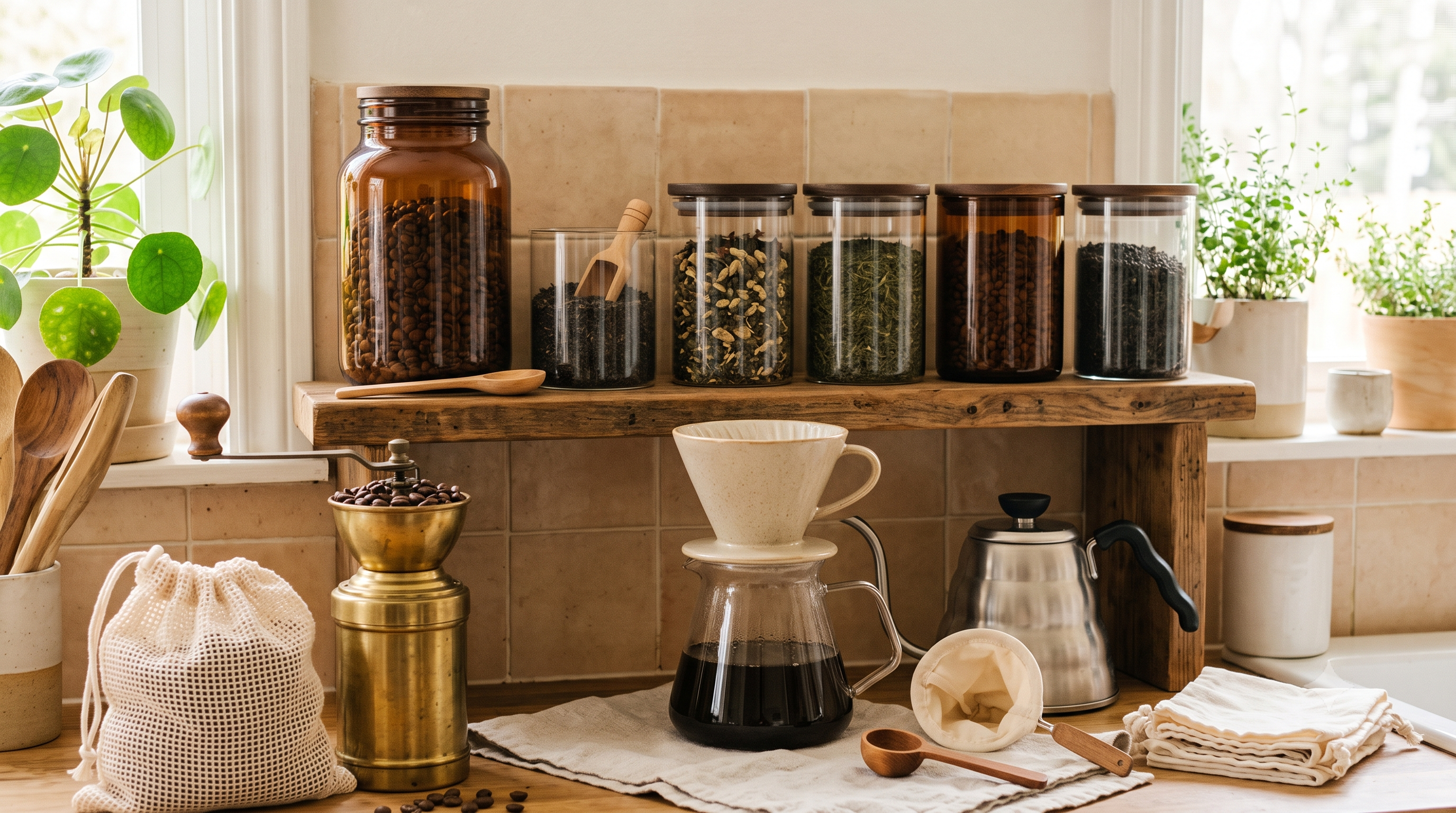
As summer entertaining winds down and the pantry starts its slow shift toward fall, it's a good moment to take stock of how coffee and tea actually get stored between uses. Most kitchens default to whatever the product shipped in — a torn-open bag clipped shut with a binder clip, a cardboard tea box left open on a shelf — which is convenient in the moment but does very little to protect flavor or freshness over time, and produces a steady trickle of packaging waste along the way.
This is the third article in our Zero-Waste Kitchen Essentials series. Our first two guides covered a summer entertaining arc — a backyard BBQ kit and a laid-back tea gathering — this one turns to something quieter but just as useful: keeping what you brew from those setups actually fresh in storage, with nothing single-use involved.
Why Storage Matters as Much as the Brewing Itself
It's easy to focus on the tools used to brew coffee and tea and overlook what happens to them in between. Coffee beans and loose-leaf tea are both sensitive to air, light, moisture, and heat — all four accelerate the breakdown of the oils and compounds responsible for flavor. A bag clipped shut with a binder clip or left folded over still lets in enough air to noticeably dull flavor within a couple of weeks, long before the coffee or tea is actually finished.
It's also worth thinking about where that coffee or tea came from in the first place, not just how it's stored once it's home. Groups like the Rainforest Alliance work with coffee- and tea-growing communities on farming practices that protect the same forests and water systems a well-stored cup is, in a small way, already trying to be considerate of.
There's a waste angle here too, separate from flavor. The Zero Waste International Alliance frames zero waste as a hierarchy that favors durable, reusable systems over disposable ones wherever it's reasonably possible — and a proper storage setup is a clear example: one container, reused indefinitely, replaces a rotating cast of bags, boxes, and twist ties that eventually get thrown away regardless of what they originally held.
Building a Storage Setup: The Core Pieces
A good coffee and tea storage setup doesn't require a full pantry overhaul, just a few pieces used consistently.
Start with the container itself. A bamboo spice storage container — sized for spices, but just as suited to loose-leaf tea or a smaller batch of coffee beans — keeps air and light out far better than a folded-over bag ever could, and it's just as easy to use for one tea variety as it is for a small rotating batch of two or three.
For coffee specifically, a bamboo coffee clip scoop solves the in-between step — it clips a bag shut securely between uses and doubles as a scoop, so there's no separate measuring spoon needed and no loose clip that goes missing in a drawer. If you brew loose-leaf tea or matcha regularly, a bamboo chashaku matcha scoop measures consistent portions each time, which also means less guesswork opening and closing a container repeatedly while you figure out the right amount.
Brewing Only What You'll Actually Use
Storage solves the "in between" problem, but the other half of freshness is brewing in quantities that don't leave excess sitting around losing flavor before you get to it. A bamboo French press is well suited to this — it's easy to brew a smaller batch for one or two people rather than a full pot that sits reheating (and losing flavor) for hours. Pairing it with bamboo stir spoons rounds out the setup for anyone who takes cream, sugar, or honey.
None of this needs to be purchased all at once. A storage and brewing setup tends to grow the same way the rest of a kitchen does — a container added here, a scoop added there, until eventually the whole system runs on reusable pieces instead of whatever packaging a product happened to ship in.
This is also a good moment, heading into a slightly slower stretch after a summer of hosting, to actually take stock of what's in the pantry rather than just adding to it. Check whether any half-finished bags of coffee or boxes of tea have been sitting open longer than they should have, and use this as the natural point to transfer whatever's left into a proper container rather than starting the new system only with future purchases.
Why This Setup Actually Preserves Flavor Better
Bamboo and glass storage vessels solve a specific problem that flexible bags and cardboard boxes can't: a rigid container with a snug-fitting lid limits the air exchange that dulls flavor over time, in a way a folded-over bag simply doesn't, no matter how tightly it's clipped.
There's a practical hygiene angle too. Bamboo is naturally antimicrobial, which is a reasonable advantage for any container that repeatedly touches food by hand — a scoop dipped into coffee or tea day after day benefits from a material that resists bacterial buildup better than plastic does under the same repeated use.
And because a storage container and scoop are meant to be reused indefinitely rather than replaced with every new bag of coffee or box of tea, the packaging waste tied to your daily cup goes down considerably over time — the bag or box the product ships in still exists, but it's opened once and emptied into a container built to last, rather than living on a shelf half-folded for weeks. The 5 Gyres Institute, which studies plastic pollution in oceans and waterways, has noted that a meaningful share of household plastic waste comes from exactly this kind of repeated single-use packaging rather than any single dramatic source — which is exactly the category a proper storage container quietly chips away at.
What to Look for When Choosing Storage Containers
Not every "airtight" container on the market delivers on the claim, and it's worth knowing what to check before you buy.
Seal quality. A snug, well-fitted lid matters more than the material it's made from — check that a container's lid seats fully and doesn't leave a visible gap, since that gap is where flavor-dulling air exchange happens.
Capacity that matches how you actually buy. A container sized for how much coffee or tea you typically have on hand at once works better than an oversized one that leaves excess headspace (and excess air) inside.
Material transparency. A brand that can speak specifically to where its bamboo is sourced and how a container is finished is generally a better sign than vague "eco-friendly" language with no supporting detail. This is also where a company's broader environmental commitments matter — at Bamboo Switch®, that's part of why we're transparent about programs like our Climate Commitment to offset shipping emissions, rather than only marketing the product material itself.
A Simple Zero-Waste Storage Checklist
If you're building this setup from scratch, here's a starting point that covers the essentials:
- A storage container with a snug-fitting lid for loose-leaf tea or coffee beans
- A coffee clip scoop to reseal an open bag between uses
- A chashaku or measuring scoop for consistent portions
- A French press or similarly sized brewer for making only what you'll actually drink
- Stir spoons for anyone who takes cream, sugar, or honey
Everything on this list gets reused indefinitely, which means each time you restock coffee or tea, less of what it shipped in ends up in the trash.
A Few Myths About Zero-Waste Coffee and Tea Storage
"A proper storage container is more effort than just using the original bag." In practice, it's a one-time transfer when you first open a new bag — after that, using a rigid container with a scoop is no more effort than folding and clipping a bag, and it protects flavor considerably better in the meantime.
"This only makes sense for people who drink coffee or tea every day." It actually matters more for occasional drinkers — a bag of coffee or tea that gets opened only once a week or two spends far more time exposed to air in a folded bag than a rigid, sealed container would allow, so proper storage helps the most exactly when consumption is slower.
"Bamboo containers can't compete with vacuum-sealed bags for freshness." A well-fitted bamboo storage container with a snug lid gets remarkably close, especially for shorter storage windows of a few weeks — the biggest freshness gains come from limiting repeated air exposure every time the container is opened, which a good lid handles regardless of vacuum sealing.
"Switching containers is expensive compared to just using the packaging it came in." The packaging is free in the sense that it comes with the product, but a storage container is a one-time purchase that gets reused for years across every future bag or box you buy — the actual cost comparison favors the container well within the first year.
Common Questions About Coffee and Tea Storage
Should coffee and tea be stored in the same type of container? Either works, though it's best to use separate containers for each — coffee and tea both absorb surrounding odors easily, and a container that's held coffee will carry a trace of it into tea stored there afterward.
Does storing coffee in the freezer actually help freshness? It's mixed — frequent opening and closing introduces condensation that can degrade beans faster than proper room-temperature storage in a sealed container. A cool, dark cabinet with a well-sealed storage container generally outperforms freezer storage for coffee you're working through within a few weeks.
What's the difference between this setup and just buying a bag with a built-in resealable zipper? A resealable zipper is better than nothing, but it's still a flexible bag, which means it holds its shape poorly as it empties and tends to trap more air with each partial closure than a rigid container does. A dedicated container solves this consistently regardless of how much product is left inside.
How long does loose-leaf tea actually stay fresh in storage? Most loose-leaf teas hold good flavor for six months to a year in a proper airtight container kept away from light and heat — considerably longer than the same tea left in a half-open box on a shelf.
Is this setup realistic for someone who buys coffee or tea in bulk? Yes — a larger storage container simply scales the same principle up, and a bulk buyer benefits even more from proper storage, since bulk coffee or tea spends a longer stretch in your pantry before it's finished.
Can I reuse the same scoop for measuring both brewing amounts and storage transfers? Yes — a single coffee clip scoop or chashaku handles both jobs well, which is part of what makes this setup simpler than juggling a separate measuring spoon and a separate bag clip.
Where This Hub Goes From Here
This is the third stop in our Zero-Waste Kitchen Essentials series, following our Summer Entertaining arc — the BBQ kit and the backyard tea gathering we covered earlier.
For now, take a look at our full Kitchen Essentials collection and consider which part of your coffee or tea routine is overdue for a proper storage setup. And if you're looking for more support along the way, Made The Bamboo Switch™ is a good place to see how other households have rebuilt their own kitchen routines one container at a time.
🌿 Continue Your Journey
Enjoyed this article? Here are three ways to take the next step:
🌱 Make The Bamboo Switch™ Learn how one small change can create lasting impact.
🌎 Made The Bamboo Switch™ Join a growing community choosing progress over perfection.
🤝 Become a Bamboo Switch Guide Help others discover thoughtful, sustainable living while earning rewards.
Share:
Setting Up a Plastic-Free Guest Bathroom
Bamboo: More Than Just a Grass